
You kids have a place. Just not with us.
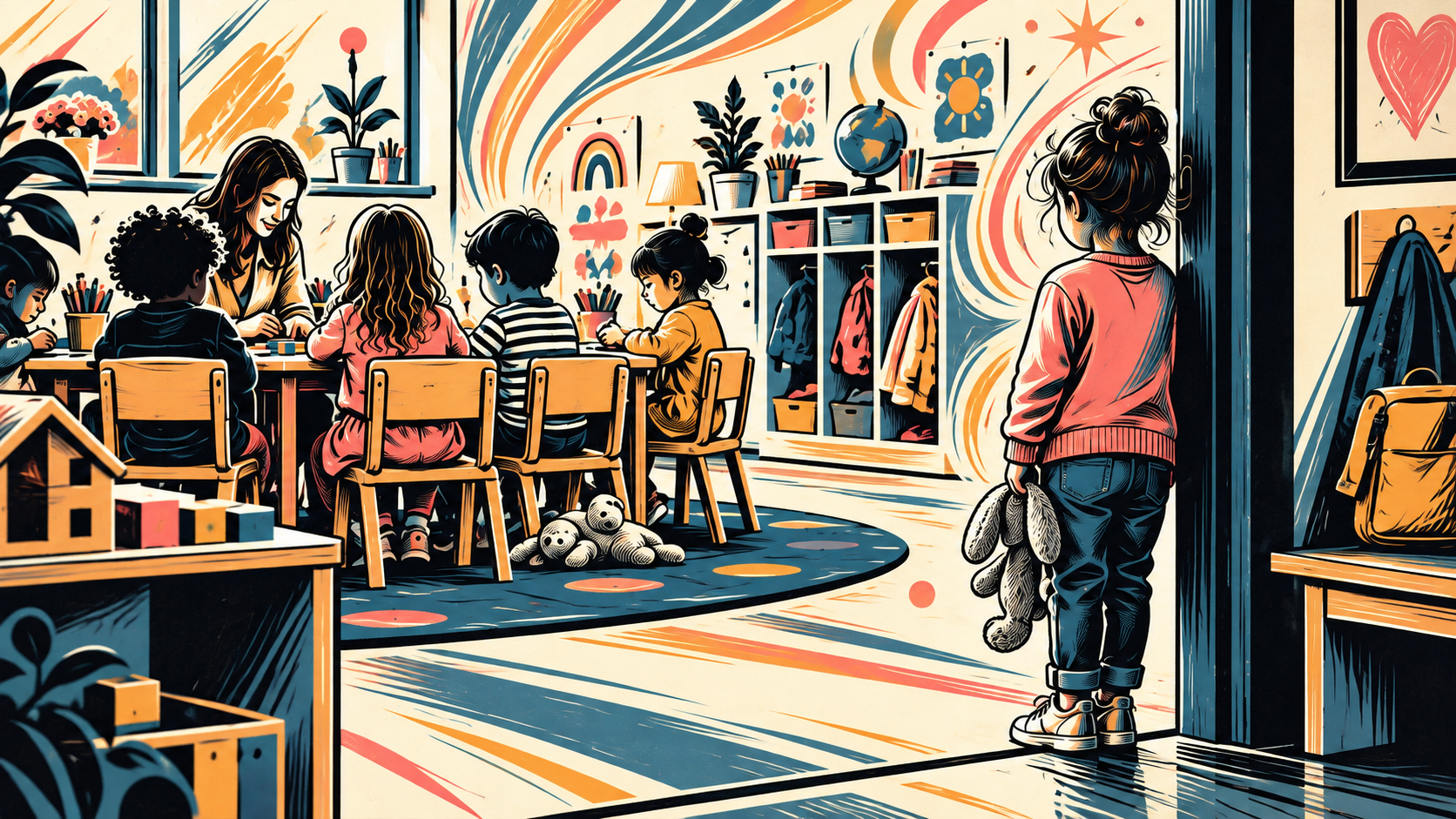
So. Here we are again.
My younger daughter's preschool told us we need to find another place for her, "sooner rather than later." Her needs are more than they can handle. I have opinions about the finer details (shocking, I know).
In all fairness, they tried to the best of their abilities. What they did is, to them, the full extent of what they could do.
However, as a parent, I expect better.
And at the same time, I don't.
My brain lives in that split. I expect more, and I expect exactly this. That's the bleakest part.
We have been here before. Different kid, different school, uncomfortably similar circumstances, same family rearranging work and care and calling around, trying to figure out where our child is supposed to go next. Where she fits in.
History repeats itself, so I am not surprised. Forgive me for still hoping people can and will do better.
I have never fully embraced the idea that people are always doing the best they can. What makes one person “do better” while another doesn't?
One behavior-change framework offers a less tidy answer: people act when capability, opportunity, and motivation align. Wanting to do better is important, but so is skill, time, staffing, habits, fear, and what the surrounding system makes possible.
Maybe "the best they can" is neither a full excuse nor a lie. Maybe it describes a limit.
And limits can still be challenged, funded, trained, and changed.
But I digress...
Preschool protections are a patchwork, and what a program is officially called can change which protections apply. In Vermont, children under eight in public schools, approved independent schools, and prequalified private pre-K programsgenerally cannot be suspended or expelled unless they pose an imminent threat of harm or danger to others. Licensed child-care programs are also supposed to work with families and professionals on a plan aimed at keeping a child enrolled before moving to expulsion. That does not mean children are never pushed out.
It means the distance between what is prohibited, what is reported, and what a family experiences can get very complicated.
As fucked as that is.
And I also recognize that the child-care workforce is burned out and understaffed, particularly when programs need qualified staff. That part is not imaginary. Vermont's 2026 Act 76 monitoring report identifies workforce shortages as the single largest barrier to expanding child care supply and reports an average 2024 child care wage of $18.93 per hour.
As fucked as that is.
But there's another reality that keeps getting swept under the rug.
What does a 3-year-old eventually make of being the person who has to leave?
Maybe she gives it a meaning I would never guess. Maybe she barely remembers it at all. I don't know. Research doesn't give me permission to pretend I know.
But uncertainty doesn't make me stop wondering.
Everyone loves to tell you kids are resilient, and I always want to ask what exactly they mean by that. Physically? Emotionally? Mentally? Because children can look "just fine" while building an entire understanding of themselves from what keeps happening around them.
Therapists would be out of a job if that weren't the case.
We can tell them all day that they're perfect just the way they are, but kids DGAF what you say. They care what you do.
And actions become information.
If you keep being the child who has to leave, what do you decide the common denominator is?
Maybe it becomes I don't belong. Maybe it becomes something is fundamentally wrong with me.
I can't prove preschool exclusion creates either belief in a particular child, and I'm not going to pretend research says something it doesn't. In fact, a systematic review found that research on the exact consequences of exclusion in early childhood remains limited, and much of the broader disciplinary literature is correlational rather than providing evidence that exclusion caused a later outcome.
But still, I ask: What does repeated experience teach when adults say one thing and the doors keep pointing somewhere else?
What does exclusion mean when you're 3? Or 5? Or 8?
Now, you might be thinking, “Wow, this is unheard of”! But I hate to tell you this: it is not.
The foundational national study found that children in state-funded pre-K were expelled at more than three times the rate of K-12 students. Boys were expelled more than 4.5 times as often as girls, and Black preschoolers about twice as often as Latino and white preschoolers.
Despite Vermont's restrictions, 46 exclusionary discipline incidents involving children enrolled in UPK were reported between October 2023 and September 2024. Forty-seven percent involved children with IEPs; 33 incidents occurred in private programs and 13 in school-based programs.
And those numbers still cannot capture every unofficial removal. Researchers call one version "soft expulsion": practices that leave a family technically free to stay but make staying practically untenable.
Yes, it even has a name.
In a 2024 study of teachers and administrators working under non-expulsion policies, about one-third of administrators, and slightly fewer teachers, reported suggesting that a school was not a good match for a child without formally requiring the child to leave. Participants also endorsed sending a child home to convince parents that the behavior was a serious concern.
And there you have it: expulsion that isn't official but also isn't an option.
So where is the line between a program reaching its limit and a society getting very good at explaining exclusion?
How many places get to say somewhere else before "somewhere else" becomes an entire system of exclusion?
How many times can we tell a child there's a place for them while every decision points them toward the next door?
What do adults get to continue believing about themselves when somebody else eventually becomes responsible for figuring out how inclusion is supposed to work?
Vermont is fucking covered in values. Black Lives Matter signs. Love is love signs. Drive around long enough, and you get a pretty clear picture of how people here understand themselves and the kind of community they believe they are creating.
We all carry around beliefs about who we are.
Eventually, life tests whether those beliefs can withstand another person's actual needs. Inclusion sounds uncomplicated until the child screams during circle time, hits another kid, needs another adult, or communicates in a way the room wasn’t built to accommodate.
Then the value stops being a sign in the yard and starts becoming an obligation.
And just how does someone think they're inclusive without much real contact with the people they believe they're including?
I don't think Vermont's whiteness is separate from any of this.
Race and disability are not the same thing. But I think overwhelmingly white communities can make it particularly easy for white people to understand themselves as inclusive without having that understanding tested very often.
We can support inclusion as an idea. We can put the signs in our yards and mean every word on them.
But meaning it is not the same as knowing what we will do when including another person becomes inconvenient, uncomfortable, disruptive, expensive, or requires us to change.
I'm not talking about the person who knows they're full of shit. That person is almost easier for me to understand.
I mean the person who sincerely believes they're accepting because nothing in their life has required them to discover the limits of that acceptance.
A belief gets a real stress test when someone needs you to rearrange a room, add an adult, tolerate disruption, spend money, rethink what "appropriate behavior" means, or admit that the way things work leaves someone out.
I keep trying to think of a word for this. Virtue signaling feels too deliberate. Performative allyship feels too deliberate too, because I think plenty of people sincerely believe they are inclusive.
Maybe it's inclusion dysphoria?
(I think I just made that up).
How much of a belief system can go largely untested when you rarely have to live alongside the people your beliefs supposedly include?
What I keep seeing here is passing the buck. One place hits its limit, and the family starts looking for the next place.
Maybe public school later. Maybe another program. Maybe more funding or another staff person or someone, somewhere, with the right mix of resources and willingness to keep your kid in the room.
"Somewhere else" starts doing a lot of fucking work.
There is evidence that capacity is not fixed. Vermont reports that UPK sites implementing its Early MTSS/Pyramid Model had suspension and expulsion rates 93% lower than non-implementing sites between fall 2024 and spring 2025. That comparison does not prove the model caused the difference.
But it does make one thing harder to deny: what a program can handle changes when its training, consultation, systems, and support change.
After enough rounds of this, I start wondering where the line actually is.
When does "we can't support this child" become exclusion?
How many places get to say "somewhere else" before "somewhere else" stops being a place?
Because to me, it just looks like this:
You kids have a place, just not with us.